Showing posts with label Uncle Landdrops. Show all posts

Thursday, March 12, 2015

My #4MTGCARDS

Praise be to the Norse God of Thunder once again, Zoners!

Today I'm gonna be a little sentimental, but I hope that's not going to keep you from reading.

My pals over at CommanderCast were following the #4MTGCards trending on Twitter the last week or so, and I thought it was a good opportunity for me to follow suit. I'm a huge advocate for using non-relevant things like trading card games as a means to constantly enlighten us and teach us about the greater experience that is life, and I think these four Commanders really exemplify what I'm about. If you're joining us from over on Twitter (which, makes me happy that you're picking up on my media, so thanks!), this is going to be a succinct, but deeper meditation on the cards I've shared today.

So here we go, in chronological order!

I'd been playing Commander for a couple years before I realized I know what I was doing. This culminated the night I threw my Intet deck against the wall.

I've written and talked about this night a lot because I think it's important for a couple of reasons. Number one, that everyone who has ever been an expert at anything has to find that space between where they are and where they want to be before a goal can be realized, and that means admitting to one's self that they are in fact bad or inexperienced with the task at hand.

I owe a lot of my development as a Magic player and enthusiast because of Grandpa Growth, and most of it stems from this moment, where he helped me to understand that what I was lacking was self-accountability in my deckbuilding. Basically, that if I was building my deck, playing my deck, and wasn't winning, there was neither luck nor anyone else to blame but me for continuing to lose. It was a tough lesson, and one that subverted a lot of my expectations, but I am the most grateful for this lesson, because it's translated into an innate trait that I not only use in Magic, but also in life.
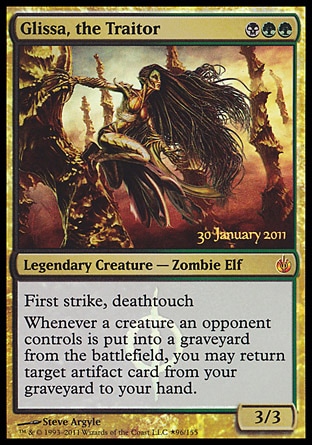
Glissa T's is one of my oldest Commanders in the current Deck Portfolio, and one of my most important. Over the years, she's evolved from being a defensive creature for a silly Infect deck to a Dollar General master to now the not-so-cleverly named, "Green Eggs and Glissa" deck I play today.

One of the great things about Glissa, the Traitor is that it is one of the only Commanders I share with Gramps here on the blog, and that's pretty cool. Gramps' Glissa deck was one of the toughest decks I grinded against back when we were grinding out games, and while not nearly as oppressive because of my playstyle and card choices, I still tend to play it more his way than my own.

Despite having a crazy power level, Glissa has helped me not only to have connections with friends from my past, but also friends in the Commander community in the future. My Editor over at CommanderCast, Mark, actually knew who I was before we'd met because of this Green Eggs and Glissa list, which is a really cool connection. Because of Gramps' crazy Glissa Engine, I'd effectively reinvented her, thereby creating an inspired Human-Glissa-Centipede, you know, without the ass to mouth.

Lu Bu is on this list, but not actually a Commander or card I've even played. It belongs to one of my best friends and fellow Zoner, Awston AKA Retardo_08.

Much like my other cards on the list, Lu Bu has a couple reasons that make it special. The first is that it taught me how to build a deck not just for myself, but for someone else. What people dislike so much about net-decking is that it often does not lend itself to sculpting and catering to the person playing it, which translates to stiff, lame, and games that are not compelling.

Awston had come to me looking to build a new deck. He loved Lu Bu, and wanted it to be risky- basically he wanted to play coin flip.dec.

Knowing him, and knowing the kinds of decks he was gonna play against (mine, mostly), this just had bad idea written all over it. Not there wasn't ways to create winning strategy- just that, without tutelage, there wasn't gonna be any consistency.

Rather than set himself up for failure, we studied and brainstormed until we were able to find the middle of this Venn Diagram, where his "risky" flavor met the Red's color pie limitations, and where those two pieces were supported by my idea of having more consistency to resemble winning strategy.

And what we invented, little did we know, was this emerging archetype of Trick Voltron. Combined with combat tricks, Final Fortune, and other Double Strike and Multiple Combat step spells, we were able to establish something together that was much stronger, and much more unique, than what the two of us would've come up with by ourselves. Overall, it's one of the decks I'm most proud of, simply because it's not something I made for me. The rivalry between Lu Bu and my Animar deck has created a long-lasting "Snake and Mongoose" battle, which has only increased the kind of excitement that we can only have here in Commander.

My last card is the Commander of a more recent addition to my Deck Portfolio, but one that I will keep together for years to come.

The reason I can't seem to stop talking about this deck is that it hits just about every mark in terms of what I want to accomplish in a given Commander game.

-He subverts the blue stigma of obligatory counterspells.
-He promotes a high level of interactivity, not just with my stuff, but with my opponents creatures as well.
-He gives me multiple lines of play as well as multiple ways to win. I've won with Milling, I've won with 40 damage, I've won with Planeswalker Limit Breaks!
-He powers up oddball cards like Hatching Plans and Stormbound Geist, while also making good cards like Gilded Drake and Reef Worm even better.
-His reactive and proactive flexibility allows me to scale his power level to all kinds of different decks and players.

And even if he didn't hit all of these points, one of the best parts about the Barrin deck was the process. It was one of the most natural, organic deck building experiences I've ever had, mostly because I didn't know who my Commander was gonna be, and at pretty much every point from design to where it is today, I have enjoyed the mystery of not knowing what the card is going to be, much less what the next game is going to look like. In this way it embodies everything that I want to do right when I think about how I want to play the format, and that pairing is in every way the force that compels me to play Magic's greatest Kitchen Table Sandbox format.

Be sure to follow me @unclelanddrops. I'd love to hear and see what your #4MTGCards are, so tell me about it somewhere, will ya?

Pass.
-UL

Thursday, February 5, 2015

Remember The Fallen #2- The Re-Reboot

Welcome back to another Thor's Day, Zoners!

So, 2015 is going to be a pretty exciting year for TGZ. We've got some fresh new writers pumping out content, Stack episodes everywhere waiting to get booted up, and several other old/new ideas that the gang and I are going to re-start. I can't wait to share it all with ya!

The first of which is a one-off series I started last year and never continued- Remember the Fallen. Kudos to you if you remember, Remember the Fallen- but if not, I'm going to tell you anyway.

(If you want, here's the first one: Remember the Fallen #1)

FACT: Some decks are going to sound awesome. Like the Xenagos Ball Lightning deck I featured in my first installment of Remember the Fallen.

FACT: Not all decks are going to be good. 

More importantly, not all decks are going to be ones that we like, let alone ones that we keep.

This is what Remember the Fallen is all about. Often, I use Better Deckbuilding as my own little primer for deck designs I like and make so that they may inspire you to take some of my tech and try your own little spin on it. 

However, because I'm a constant deckbuilder, and again, I can't like every design I make, there are some real bad ones that often get dismantled or abandoned quickly throughout my deckbuilding process. And because I believe it is important to show that I am not a machine that gets it right every time, we're going to make time and place so I can show you all the deck designs that didn't quite make it- which might inspire a few of you to share your lists and show me a thing or two. 

So let's get started (again!)


Prime Speaker Zegana, aka PSZ, is a card that I've openly admitted I was entirely wrong to be disappointed with when she got spoiled back in Gatecrash. Everything about this card is right, I don't know what I was thinking, mea culpa like twenty-thousand times to William Murai for the brilliant art, as well as Design and Development for a fully functioning Simic Alternative.

And because it is well known that my love for Simic is moderately infinite, I did take her for a test drive last Fall.

The design was difficult- I didn't want to make the Control/Hexproof Dinosaurs deck, or this neat little Loam/Land Play deck that looked really solid.

I settled on a Wizard-Tribal/Combo deck, which ended up being not bad. Unlike some of my designs that don't make it past the Goldfish rounds, the 1v1 and multiplayer test drives did yield some victories.

Door of Destinies in conjunction with Master Biomancer set up Fathom Mage to always Evolve, as well as create some hilariously big Thought Couriers.

My big combos in the deck involved Biovisionary or Lab Maniac, so I was either drawing into a Rite of Replication or drawing everything. Oh, yeah- and I got to play Prophet of Kruphix. #HagridToldHimHeWasAWizard

Ultimately, the counterspells made the deck durdle, and the combos went stale quickly, mostly because the set up was very similar to Azami. There was just too many big-time, one-trick things in this deck to keep my interest in it long term, so I pulled off a Lab Maniac combo, a Biovisionary combo, and retired it.

So another year, another Boros deck dismantled. That seems to be a common thing for me as I continue to search for the right one for me in Red and White.

I'll admit the reason Anax and Cymede failed was a lot on me in deck design.

The concept seemed cool- Auras combined with Trick Voltron to make for a little Aggro deck with opportunities for multiple Heroic triggers. I'd done some serious Gatherer searching for Auras like Flickering Ward and Ghitu Firebreathing, which could be bounced and re-cast for Heroic value. Coupled with a few nice Storm spells like Astral Steel, I thought this was going to make for a nice deck.

What went wrong was two things. The first was that I forgot that mana was required, not only to bounce the enchantment, but to also re-cast it. Not compensating for this, the deck had a heck of a time repeating and resetting the effects of the Auras as many times as I wanted.

The other thing I got wrong, which was dumb, was a rules oversight with regards to Storm. Any copies I got off of Storm weren't going to trigger Heroic because, guess what? WE DON'T ACTUALLY CAST THE COPIES OFF OF STORM!

Those were probably the two biggest blunders I made in design, but there were actually two additional issues that broke the camel's back, leading to deck demolition.

The third problem was that we were swimming in options. What I mean is that I really threw every Heroic card I could play into the deck so I could figure out what, if any, were going to work. Like, do I always target A & C to get pumps and trample? Do I target this Vanguard of Brimaz to get Cat Tokens?

Having so many different options may sound good, but design-wise, none of these cards were big enough to get around creatures, so we were always making a sacrifice, and that's without trying to account for removal.

The last issue was just one I've had with all Boros decks I've made since the beginning of time- I never seem to have enough cards in my hand. While I like to think that I've become a better Aggro player, I'm still a calculating one. I take chances when I can, play tricks to protect my stuff, and most of my designs can support the tempo I want to play at.

Because of the innate need for R/W to get wide, I feel like I'm constantly over-committing to the board state, putting myself on a clock that's going to run out faster than I want. Clearly, I'm doing something wrong, and I've got to fix it- until then, the search continues!

I talked about Mirko a little bit in my strategy column over on CommanderCast, but I thought I'd get a little bit more in-depth about what was going on.

I'm still on the lookout for my Mill Commander. I'm also on the lookout for having a deck that's fun, that can win, but that I'm just as comfortable losing with. I'm also looking to have a successful Dimir deck at some point.

So against my better judgment, I threw together a scraggly-little Mill deck so I wouldn't be so behind while Mesmeric Orb was trending on Twitter (NOTE: I don't know if that's true. I actually don't Twitter). Fact though- Sidisi has made this Mesmeric Orb a pretty known quantity.

At first, I thought I might have some hope. Mirko, being just the right amount of unplayable, could come in under the radar and take away/potentially give my opponents a bunch of cards.

Ultimately, the deck got taken apart because it was just too slow. No joke- I did at least 18 damage with Mirko by the time I had an opponent's library in the Shelldock Isle zone (That's 20 cards or less, in case you've forgotten your Hideaway lands), and I just thought, "That's too much for not enough." The deck was working, and I could've probably made it better, but I just didn't want to spend any more time goofing off.

Well, that's all I have for now. Before I go, here's a link to the Milling article published yesterday over on the Big Brothership, CommanderCast:

Mill-osophy

Also- Here's a link to my first podcast, in which I got to guest interview one of the creators of Tiny Leaders, Steven Hamonic.

CommanderCast #185- Tiny Leaders (and I'm on it!)

As always, my failures hopefully lead to your gain. If you've got decklists featuring any of these Fallen heroes, or you've seen some in action, and they have a nice online list for us to look at, share them with us!

Thanks! Turn's To You.

-UL


Thursday, January 29, 2015

Better Deckbuilding: Titania, Protector of Argoth

After about 3-4 games playtesting this Titania brew, I texted Grandpa Growth something to the effect of, "You remember those Green Loam decks we were trying to play three years ago? Titania was the General we were looking for, and it's just too damn good."

Of course, Gramps doesn't get out of bed for anything less than Emrakul unbannings and/or the reprint of Strip Mine, so he gave me his typical, "You need to hold your horses/I have to see this with my own two eyes/Why do you overexaggerate about nonsense all the time?" response, and I brought my exaggerations down to earth, and that was that. In all fairness, the last time I talked like this, the debate was about Ruric Thar, which wasn't earth shattering, but also not as overwhelming as I'd anticipated.

All of this was some time in December, post-C14 release, and so I kept my mouth shut, tested this deck, and held it over as the first Better Deckbuilding of 2015 so I could research and test and tweak and prove that Titania is every bit the unstoppable force I thought she was.

So I'm beyond stoked to talk about Titania today (say that five times fast), not only because this deck is straight up OP, but because I get to talk about value, token-beatdowns, and my absolute favorite part of any Magic deck I've ever made- The Got-Damn Land.

WHY TITANIA? 

I wasn't going to build this deck. My playgroup actually has a pretty traditional precedent set where we make conscious efforts not to override someone else's Legendary Creature as a Commander, and that's what I thought was going to happen. Whenever there's a new product coming, we tend to call "dibs," which is silly, but we do try to be gentlemanly (I would've been more gender neutral, but we're all dudes these days) about it. Another guy did, and though I was chomping at the bit, I had no problem with this. I tend to give my group the first crack at new cards. Decks fall in and out of favor all the time with us, so there is some inheritance of a Commander when another player decides to retire decks.

Right before the release of C14, I'd begun to assemble a Loam deck with Xira Arien, based on a list I'd found scrolling through rogue decks in MTG Salvation. Once I'd gotten that silly-looking little bug in the mail though, I wasn't really feeling the deck design at all. 
This happens a lot more than I admit, but it's not that I'm unwilling to talk about it- there's just not much to say when I scrap a design. I find zero shame in shelving a deck that you aren't consciously and continuously motivated to play and re-tool throughout the deckbuilding process and its ensuing sleeved-up career, so I went back to the drawing board.

Then, I was getting ready to go play some 1v1 and I decided, "Screw it. I'm gonna play Titania with this Loam stuff and see what's up. If I have to take it apart, I will, but I can't help myself." Although the pieces to a Jund Loam deck were together, building around Titania at the helm was probably one of the quickest, most natural decks I've ever assembled. That's what will happen when cards and combos are floating around in the ol' noggin. It was literally world-record timing for me. From choices to fully sleeved, it was less than 40 minutes. That even included a couple Magic Solitaire/Goldfish tests.

So I played it with the idea that if it was any good, I'd be a sport and ask if it was okay.

Sure enough, it was all these things, my courteous takeover was fine, and my badass beatdown Titania deck was born. 

THE STRATEGY

Lands. Lands are our strategy- playing multiple lands per turn, playing a bunch of non-basics for utility- and then of course, making sure they end up in the graveyard with Titania out so we can beat down with 5/3 Elementals. 

I like to categorize my decks, and I think the best phrase for it is "Aggro-Loam Token Engine." With the extra value Titania generates, we are able to increase the value of the Tec Edge/Wasteland/Ghost Quarter/Strip Mine/Dust Bowl suite by grabbing some cards to go on the offensive. With help from cards that give us extra land plays, as well as the creation of an engine via Life from the Loam, we have the strongest mono-Green graveyard deck in current existence, as well as one of the strongest pure-value engines I've ever seen.

THE TECH

Working our way towards the stronger cards, we'll start with the most obscure and "not terrible."

Arcane Spyglass, without Titania, is probably one of the fairest cards. We don't draw a single card until we have 6 mana, and then we actually have less than 6 mana (the assumption being we don't have mana rocks).

It may not be as absurd as some of my other tech (Sylvan Library, Horn of Greed), but I designed the deck with some serious draw power. There are upwards for 45 lands in this deck, and so digging with our extra resources will yield value that isn't always contingent on having a Titania in play.

However, if she happens to be around, which she usually is, we end up with a midrange creature that will probably have some friends. Also, for every three lands we sacrifice, we get a free card.


Creeping Renaissance has been experiencing an actual creeping renaissance in my metagame, and though most people would be content to say, "Shit man, that's awesome," and move on from literal flavor being IRL flavor, I am not one of those souls. There's always more, and I always want it.

In fact, the coolest part about Creeping Renaissance's creeping renaissance is the fact that we're all playing it in decks for COMPLETELY DIFFERENT SET OF PERMANENTS!

Titania, like me and Brick Tamland, loves Land, our Sidisi player loves to make Zombies and get the ones he's milled away, and our Cromat player gets back all his Superfriends. Like eating Reese's Peanut Butter Cups, there's just no wrong way you can go when playing this card. 

When I don't get Lands back with Renaissance, I'm probably looking for all the cards my Bane of Progress has blown up.

We haven't talked about them yet, but because of the nature of the land-driven-token-generating that his happening, I really like the all-in Wrath effects. Most of my creatures are expendable, and the ones that aren't, I'm not attached to them. Titania is the biggest part of the deck, and because of the way she creates value with her ETB trigger, we will usually have plenty of land to cast her.

As far as Bane of Progress goes, he's powered up in design. Nicknamed after a bygone song from a bygone Teen Pop band in the lost years of the mid 90's, "mmmBoP" here is one of the better ways to police the board. I've struggled since C13 to find the right home for him, simply because I didn't like that he got in the way of my stuff, but again, I don't mind it so much here. I can play around or deal without the noncreature permanents I invest in, and when I need a big thing, he is the big thing.

So far, my high score with Bane of Progress is fifteen +1/+1 counters, without Enchanted Evening or Mycosynth Lattice or Doubling Season/Vorel effects. I'd like to keep track of the high scores in this mini-game, so leave me a comment if you've beaten it. 

For the last year and a half or so, I was actually cutting most of my O-Stones out of decks. What I found was that timely spot removal was really getting the job done, so I went with more of that and less Wrath effects.

Disk and Stone are solid options for decks with expendable creatures, or ones with ways to generate advantages out of them. Most of my Disks and Stones are back in decks now where the design supports them better, like Karn, where I can protect them with Darksteel Forge or Soul of New Phyrexia, or my the topic of my next Better Deckbuilding segment, Obzedat, where investing in Obzedat and having an Instant-speed activation ensures my guild leaders are going to take a couple chunks of damage out of a life total.


The best cards in Titania are the ones you don't expect. By now, I'm sure the Internet has gotten real wise to just how insanely powerful Titania can be with this, but it's still worth mentioning we use it, and more importantly, how it's used.

Zuran Orb, much like Sylvan Safekeeper, should be an actual game-ender in this deck. With Titania out, we can always make enough tokens at Instant speed at the end of someone's turn so we can compensate for blockers whilst avoiding most Wrath effects.

Personally, I don't prefer to use this ability sparingly. By that I mean that I have no problem sacrificing most of my lands if need be. Again, this is a little bit bold, but I've found that what separates the mediocre Aggro player from a better one is not the blind risk, and attacking every turn if able- it's knowing how to manipulate your own momentum by preventing Control players from buying extra turns on the damage clock.

Rites of Flourishing has been long recognized as part of the 99 of most Group Hug decks.

I do not support this archetype at all (another article I will be writing for Commander Cast, as I continue to foreshadow future segements), but this is a card I tend to play with a little more caution when I put it in decks.

The thing most people don't realize is that the secret to successful decks with RoF is that the winner is the player whom consistently plays the additional land that this card allows, thereby maximizing its value.

With 45-47 lands in the deck, we can support this card nicely while also using it to dig. In combination with use and re-use of Fetches, Panoramas, and Myriad Landscape, this is usually not about generosity. Sometimes, you have to help others get ahead so you can. This is clearly what's going on here.


There's a pretty extensive Land Destruction package in the deck. With Crucible, and access to cards with extra land plays, there is plenty of opportunity to play a heavy resource denial strategy.

The cool thing about the Strip Mines and Ghost Quarters is that we have additional options for targets in our little Loam engine. We can control our opponent's lands, and in the process, we gain extra creatures.

What's cool about Ghost Quarter is that grabs more land out of the deck when we do this. The value, again, is just overflowing here.

One of the obvious includes in the deck are cards with Landfall triggers. Of course, most people will be holding up their removal for Avenger of Zendikar and Rampaging Baloths, which can get really out of hand.

Grazing Gladehart, on the other hand, has a really nice home here in the deck because of the bigger targets and tokens in the deck. Before our little Antelope meets his end, the opportunity to gain upwards of 10+ life is significant.

The last card I want to talk about is Arashi, the Sky Asunder.

Although the art for this creature looks like it's lacking one, there is plenty of punch here.

Captain Sisay players can probably attest to the excellent utility Channel adds to its deck design.

In Titania, I replicate this a little bit with my Time of Need package. It's exponentially smaller, but there's only three creatures I really need at various stages of the game: Azusa, Kamahl, and Arashi.

Green typically has some issues with flying, and this is a way I've found to get to my answer, should I not get my go-to Silklash Spider.

Per usual, here's the full list. Feel free to drop me a comment, +1, or whatever.

I Love Land- Titania EDH

We've got a new look, some new people, and I'm pretty excited to be inching towards Year 3 of TGZ. Thanks for making it happen!

Pass.
-UL

Thursday, January 1, 2015

Card Corner: Narset, Enlightened Master

Feel the rhythm, feel the rhyme- What's that sound?

It's Card Corner time!

Happy New Year's Zoners. I know I reserved this column to talk about niche, questionable, or sometimes downright awful EDH technology, but today we're going to talk about Narset, who is, in my opinion, the best Commander of 2014.

Yeah, as impossible as it may seem, the American wedge finally has a "bobsled team." And it's led by a 6-cost, 3/2 with hexproof.

All of these weird things I'm saying are cinematic allusions from the 90's oddball masterpiece Cool Runnings, where John Candy plays a coach who seeks Winter Olympic redemption by bringing an unlikely group of Jamaicans into the bobsledding scene. And it works!

I think that's the theme for Narset here. Despite being in a difficult color combination, despite being undersized for her converted mana cost, I find that the sum of her qualities work to create a pretty powerful dose of combat-infused value akin to some of Commander's biggest and baddest.

Where most people see these weaknesses, there is actually strength, leading to a strong relational design. What I mean is that the abilities feel pre-meditated, planned, and developed well in testing so that she yields high potential energy without being innately overpowered.

Anyone who's been playing on Cockatrice or MTGO has probably seen this deck accomplishing what Jeleva was attempting to do last year- cast every Time Warp and Relentless Assault- spell imaginable. And chances are, they're going "21 and done" at a strangely consistent rate.

This is because Narset, as I mentioned, is more balanced than Zur and Jeleva. What she lacks in evasion she makes up for in power, toughness, and static abilities. Her 3 power gives her a meaty first strike and an amount of damage that could be left unblocked on a first swing. Hexproof nerfs targeted removal, ensuring opportunity for attack and forcing your opponents to play more Wraths, Edicts, and/or Arcane Laboratory if they want to have answers to the Jeskai Khan.

Perhaps the biggest pitfall is her converted mana cost. It's a lot sure, but it's actually my favorite part. Costing six, combined with an alternate set of static abilities makes her a prime target for all three Scourge Dragon enchantments- Dragon Scales, Dragon Breath, and Dragon Wings.

Not only are these cards cheap to cast, but they have the potential to always be free, attaching to Narset every time she comes in, granting her any combination of Haste and Firebreathing, +1/+2 and Vigilance, or Flying and Cycling. Unlike some of the other enchantress deck options, the power is always at its maximum, thanks to Hexproof and CMC. Short of a Torpor Orb or Hushwing Gryff, these are always going to be relevant enablers in conjunction with ye olde Swords of X and Y, and all the other free non-creature spells you're going to flip and cast.

Overall, I believe this makes Narset the "Most Voltron" Voltron General ever printed, as well as a deck that can enable successful creatureless builds.

Again, enjoy January 1, Zoners. Feel free to share your thoughts with Narset or any of the new Fate Reforged spoilz in the comments below. Have a good one, and always remember- Friends Don't Let Friends Play The Mimeoplasm.

Pass.
-UL


Saturday, December 20, 2014

My Decks, The Tech, At Year's End.

Happy Last Shopping Weekend Zoners!

Today, we're going to take a quick walk through my Deck Portfolio. I've done a lot of re-tooling this year on most of the stuff that's come through the Better Deckbuilding series, and I thought it'd be a good idea to re-visit what I've been playing and show you the fresh-er tech from the changelog.

Let's go in alphabetical order.

THE ANIMAR DECK
The Thug in RUG got a huge mana upgrade with the scry lands, as well as some moderate pimping as I've started to collect some choice artwork and the cheaper foils. I snapped up copies of all the Duels Titans over the last year, and a few nice promo arts of Mulldrifter, Sakura-Tribe Elder, the cutest foil Pilgrim's Eye, and a cheeky foil Sigiled Skink. I was gifted a foil Clone from a Core Set and foil Archetype of Imagination, which acts as another copy of Sun Quan.

The non-block content was kind to my boy too, getting a sweet Conspiracy card in Dack's Duplicate, and a really excellent support card in Thunderfoot Baloth. I haven't added a Clever Impersonator, but if I can get a foil, I totally will.

BARRIN, MISTER WIZARD


This Barrin deck has been probably the most surprising and most rewarding deck I've built this year. Stacked to the brim with a bunch of cards that I like, I've had a significant amount of fun grinding out games trying to figure out how I'm going to win.

Playing and building this deck has helped me to forge a stronger understanding of myself and the cards I want to play, which has really changed my technical approach of building on TappedOut and scrolling through Gatherer. I still do these things, but putting cards in your hand in the decision-making process is always going to be helpful.

Reef Worm has been my top performer in this deck, probably by a mile. I think the $5 price tag on him explains a lot, but with Barrin, I have ways of ensuring that I get to release the proverbial Kraken. Teferi, Temporal Adept hasn't been too shabby here either, but not as good as Aetherspouts and Polymorphist's Jest, which are possibly better than they look.

GREEN EGGS AND GLISSA

Wanting to get more excited about Glissa, I took off her Dollar General Salary Cap, but kept her namesake's promise intact. In fact, we went old School with the removal, adding Smokestack and Triangle of War, the latter of which being pretty one-sided with a handful of Deathtouch and some seriously big bodies.

The biggest shakeup with Glissa was that she got more threats. She got my Jitte, my Soul(of New Phyrexia), a Spirit(monger) with new art, and a pimpin' promo Thopter Assembly. Oh, and a Doom Engine, that's been known to do a bit of Scuttling.

Still, the best changes I made were to gain some flexibility. Enter Vedalken Orrery, and a foil Shimmer Myr (pronounced Sher-mur-mur), which have been stronger than I thought. All in all the curve got bigger, but the deck got better.

HEARTLESS HIDETSUGU

Me and HH have been through a lot. In the beginning,  he entertained Kiki-Jiki, Siege-Gang Commander, Zealous Conscripts, and a whole host of over-costed removal and burn spells.

This last year, HH has been through a few different transitions. Being probably the most-played of all of my decks, he's seen a lot more cards in his squad. For the first half of the year, I played an eclectic build with Defenders. Post-Khans, I rocked some of the better Morph creatures.

The creature base is still something that needs work, and I like where it's going without the themes. Fortune Thief was a nice pickup, and actually put me in position to win a couple of times. Soul of Shandalar, Impact Resonance, and Flamekin Village were all nice grabs too.

But Daretti though! Probably one of the best Red cards Wizards has printed for us in the last two years. Depending on how you feel about his Commander-ability, he could potentially be among the top Commanders, next to Purphoros. Personally, I'm just happy to see another Red card that gives me access to "Rummaging" aka "Reverse-Looting" effects. Really, he's put this new Sarkhan to shame in terms of deck performance. We shouldn't stop talking about him. All hail Daretti, that glorious spider-wheelchair driving, goblin pope son of a bitch. Red is trending upwards folks. This calls for a Shiva Blast.

WHO'S THAT GIRL? NOT JESS...


Obvious Zooey Deschanel sitcom references aside, it's a fact here on the blog that I Love Land, and I'm not just looking around the room and just saying I love it.

I also love Titania. If there was no Narset in Khans, I think Titania would easily be the best new Commander.

It is for these reasons that Silvos got retired to the great pool of cards sitting in cardboard box on my desk. I Love Land, so does Titania, and she enables the Aggro-Loam deck that Grandpa Growth and I have both attempted to make in various capacities over the years.

The deck has practically built itself, but I've got a few more cards to tune and tweak for the first Better Deckbuilding of 2015. So stay tuned for that.

"THIN LIZZY," DEFIANT HERO

Lin Sivvi has had plenty of power since I designed the deck in the latter half of last year. I really wish I could get more games in with her, but the truth is that she's always going to be a Quality over Quantity kinda gal. So even though she doesn't get a whole lot of play due to time constraints, she's always playing for the long game, which brings the dynamic back to equilibrium.

This is probably a deck I could dedicate some more time to re-tooling in the next year. She's received an equal amount of attention relative to the basic upgrades I made in all of my mono-colored decks (you know, Deal Brokers, Myriad Landscapes, Blasted Landscapes, etc.), but only a handful of other cards have been slapped in. Jazzy G (Jazal Goldmane) found a home in place of a Heliod which I didn't think helped a whole heck of a lot. Arcane Lighthouse is a good tutorable option to help me better spot remove. I was able to trade for an Entreat the Angels. This deck burst onto the scene with a lot of power, so it's just been baby steps. I don't need to invent new ways to win- just new ways to play Mirror Entity.

SAFFI, DA BROKEST

My favorite infinite martyr got some scry land, but didn't need much more upgrading than a Deal Broker. She's such a boss that it wasn't necessary.

KARN AKA MR. BROWNSTONE

We talked about my Karn deck last week, so there isn't much to tell other than the fact that I just traded for a Planar Portal. He gets played, he combos, or we get conquered.

THE REST

We can take a moment of silence for Greel, but I'm not mourning any of the decks that didn't last this year. Greel was one of the most economically sensible approaches to mono-Black, and I wouldn't be surprised if I tried to bring him back. For now though, I'm going to be looking for something new to slot in his place in the portfolio.

In the meantime, I'm rocking Lyzolda, and Obzedat as adequate color replacements. So look forward to stories about them as well.

The last bit of news is pretty sweet. I know you guys haven't seen a lot of me this year, but I'll be ever-present in the online Commander content moving forward. In addition to running TGZ, your home for me and GG's awesome opinions and insight, I will also be writing for CommanderCast.

CommanderCast has produced some of my favorite non-TGZ content over the years, even given me a good framework for sharing all the Super-Secret-Tech I do here. So be sure to peruse the archive and check out the rest of their stuff. They worship Wrexial, Ib Halfheart, and the ever-flavorful Giant Shark, so you know it's good.

My first article runs next week, so if you need to escape the pesky cousins or obnoxious, clueless aunts, uncles, and/or grandparents, you can read how I use basic Poker techniques to improve my Commander game.

Well, that's all I got. All the lists are on TappedOut if you want to check 'em out, +1, and/or follow me.

Anyway, Be Safe, Make Good Choices, Happy Holidays, Pass Turn.

-UL


Tuesday, May 13, 2014

Easy Deck Pimping

Heya Zoners!

For most, pimping out an EDH deck means going foreign, foil, or both. Obviously, that's not going to come cheap.

So today, I'd like to run down a few subtle, less expensive ways to improve the deck aesthetic.

LANDS

Getting a uniform mana base is one of the cheapest ways to make your deck look nice. Strategically, this is more relevant in decks that run green. This is because your opponents can actually keep track of your land if they can remember the artwork and set. For example, the Zendikar full art lands, or any of the white border lands tend to stick out if someone goes to search for them. Unless the deck is playing all Zendikar lands, or they're all white-bordered, this could be easy to see.

Still, this is not just color-specific. While having a varying mana base can be a great way for you to count cards and study your own shuffle mechanics, it can also create distraction for you and your opponents. So there is value to collecting basics from each set, if that's what you like.

My favorite way is to try and collect lands with the same art and design template. Wizards of the Coast frequently reprints lands, so the set symbol won't necessarily matter more than the condition of a card.

With most basic lands and some specialties like Zendikar full art, obtaining uniformity might be a little trickier, so if you can't do it, focus on template more than artwork at first. Remember to pay special attention to "T" for tap versus the tap symbol, or just the big symbol in the box, etc. The more uniform the lands look, the less distracting and more impressive it looks on the battlefield.

Picking an artwork you like is cool (I'm partial to Ravnica and Return to Ravnica basics myself), but there is a further step you can take here- matching it to your Commander.

Mirage Plains Version C, which is here to my left, is one of the closest I found to matching the color palette for my Lin Sivvi deck. Not only is does it match color wise, but it's also a land from an older template, so it's yet another level of pimping.

Although it's a relatively old set, the only challenge is getting enough of them together for a mono-colored deck. Most of the old lands can be bought for less $.25, so re-doing lands won't cost more than $20 US plus shipping.

Doing multiple colors could be even easier, as the number of lands per color decrease, so you won't have to trade or buy from multiple places.

ALTERNATE ARTWORK

Although there are many played cards re-printed at FNM, GameDay, Prerelease, and for Judges, most of these cards are either a few bucks more or astronomically more than their originals. Obviously, we're not talking about old-bordered Swords reprints, or a full art Doran, or the new bordered Force of Will scheduled to come out soon.

What I'm talking about is something like altered Sakura-Tribe Elder, Elvish Visionary, or like the Everflowing Chalice below.

Between Duel Decks, Commander Products, and From The Vault, Wizards is always coming out with cool, different versions of cards every year. Like my old-bordered Dromar deck, having a deck featuring all alternate artwork has started to become a design theme, which is a nice way to be pimp without breaking the bank. Also, it's a lot more doable if you play multiple Magic formats and do well in those environments.

Back to this Everflowing Chalice. Some times, the color of the art is also more on theme. To me, this version is a lot better to look at, but the original artwork has more pink, so it might look nicer in an Aurelia deck, if we're going off of the Commander background.

Older sets also had different artworks for a lot of the same cards. Fallen Empires has three different copies of Hymn To Tourach. Additionally, there are many Core Set reprints for basic utility spells, like Naturalize and Disenchant. Now, I'm not condoning a huge compromise for themes, but picking out versions of cards that have a more aligned visual cohesion with your deck is more impressive to me than just finding whatever you can in foil.

SLEEVES

The last way, and perhaps the overall cheapest way to pimp a deck, is with sleeves.

I'll admit I'm a sleeve snob. Though they tend to break a lot, and are cut even worse, I prefer the color and texture-back Ultra Pro sleeves. I played a lot of Player's Choice and KMC at the beginning, but Ultra Pro tends to last better, I don't have artwork to protect, and they don't get "sticky."

As we've been talking about pimping, the ultimate principle of pimping has been to align and cater our stuff to fit our Commander. This is no different.

My requirements aren't so picky, but I do tend to avoid sleeving up a deck when my Commander looks bad in a certain color of sleeves. My original mono-colored decks all have sleeves that match their color identity, and my multi-colored ones have aesthetically pleasing alternatives.

Another great way to match up sleeves with your deck is to make them align with your theme. Recently, I've strayed from my loyalties to Ultra Pro and purchased these sweet House Stark sleeves as a pretty nice home for my new Isamaru deck.

Although he's not a direwolf, the artwork on the 2/2 hound and the backs of these sleeves have a similar menacing pose which, once again, really ties the deck together.

Now, I know none of this really should have an effect on how you play any deck, be it good or bad.

Still, any and all of these are little tweaks and adjustments you can make to help further your "connection" with the deck. This all about staying excited and wanting to keep certain decks around, and most times, just finding the right sleeves is enough to renew vigor in a deck you may have lost interest in playing.

If you have any cool ways to pimp out your deck that I've missed, or you'd would like me to help you pimp something out, leave me a comment below.

Have a great one. Turn's to you.
-UL


Thursday, March 27, 2014

UL's "Better" Deckbuilding: Doran's Siege Tower Defense Squad EDH

Happy Almost Friday Zoners!

A month or so ago I promised you the results of several different Commanders that I'd been re-invigorated to try with new lists- Sygg, River Cutthroat, Momir Vig, and my favorite Happy Tree Friend, Doran, the Siege Tower, which I'm excited to share with you here on TGZ.

LAST TIME WE SAW DORAN...

A while back I was rocking a list I called "Doran the Explorer," which was an extensive low-CMC Enchantment Voltron deck mostly for use in 1v1.

After a while, the deck got pretty boring, and I was forced once again to ask the beloved Siege Tower for his Matrix of Leadership. Reluctant, but not discouraged, the big Treefolk receded into my binder, waiting for his chance again.

Because if you're a unique Legend in sweet colors with a fun and exciting ability, you're never out of the game for too long.

SO WHY DORAN AGAIN?

Earlier this year I was re-examining the various hilarious Doran Defender lists and made an interesting discovery- there wasn't a single list wholly committed to the Wall strategy.

Naturally, this gave me a challenge, and a chance for me to get Doran out of the binder once more.

That, and I'm a sucker for the flavor text.

THE RESTRICTIONS

Obviously, there's no creature in the main deck without Defender. But there are a few other nice subthemes included in the deck to help support our lack of consistent attacking "threats."

The next is a looser definition of Life Gain. Most people think of Life Gain decks and their minds jump to Test of Endurance, Celestial Mantle, Beacon of Immortality, Storm Herd, etc.- big, "beat-me-over-the-head" obvious cards that make your plan very obvious, and cost you a card slot in doing so.

Instead, what we're talking about here is the inherent value lost when you cast a creature and decide not to attack, for fear of dedicating resources to a futile cause, or fear of losing the creature in combat for an uneven trade. In either case, forcing your opponents not to attack you, but to go after someone more open at the table not only nets you life, but also influences them to pick off the easier targets. So playing defenders, in this case, is kind of like politics- except you don't have to say anything. By giving up your ability to attack, your defense is secure, and the more impatient Aggro-players at the table looking to get in the red zone have to find relevant removal or evasion.

However, backed up with an adequate amount of Wrath effects, we create another significant value bump. Since our opponents can only really hope to get quality evasion, or waste removal spells on Doran or one of his silly walls, we can actually force our opponent(s) to over-extend, creating quite a bit of card advantage via attrition. We can also play Planeswalkers, which, when protected by our walls, can further create value and keep combat damage away from us, thereby "gaining" more life.

The third theme is "tutorless." Now, some people might define that as zero cards containing "search your library." Here, I do have the Kodama's Reach suite of ramp, but nothing else. So I still have to draw into answers and game enders.

SO HOW DOES THIS DECK WIN? 

We've got several ways to win once we're able to get a few Walls online and protect our board state. Some are obvious cards that are powered-up by the lack of real threats in this deck. Some are just purely janky plans that should never happen if the game is going well. It is these two polarizing qualities that make this Doran list a pretty interesting little deck.

THE JANK

Rolling Stones here is one of the few enablers I have to jailbreak my creatures from the self-inflicted bonds that hold them.

Obviously, this kind of card has to be played with a lot of planning. Between Mick Jagger and Co. and Wakestone Gargoyle, there's really no way to get damage in. Even with this card out, we still have to have Doran in play to deal maximum damage.

Truly, it is a silly combo. However, if we're steadily eating our opponent's removal and they can't keep a consistent stream of cards in hand in the late game, there's a chance we can win.

Wall of Blood is perhaps my favorite "win-condition." Combined with Animate Wall, Warmonger's Chariot, or Rolling Stones above, we can usually get a nice chunk of damage in on our opponents in the late because our life total is just so much more lopsided.

The scalp count is up to two already at this point with Wall of Blood, and I've already been told that this dumb little card will never be underestimated again. It was not expected that I would pump Wall's power to lethal. Though the first was a very silly play early on in a 5-man pod that caused me to go to 5 life, it's worth the sacrifice to tell the story and call your opponent's bluff. Keeping your habits unpredictable amongst your play group is a formidable trait, and it can even make a difference in the game. Lesson learned.

THE BOOM BOOMS

Really, the best ways for me to win are through D to the D and Exsanguinate. Tipping the life total scales means I have to do a lot less work.

Normally, I find these cards pretty boring. In decks where there's already decent, established power amongst most of the cards, this is just a boring end to a boring game.

However, what I've found is that by making this and Exsanguinate the best of a handful of ways for me to win, I'm more satisfied with casting them, and my opponents suffer less dissatisfaction with a loss.

The deck is designed to support using these cards in the mid-to-late parts of the game, with a few ways to dig them back out of the graveyard in case of emergency.

Karn, ye olde Sorin Markov, and Vraska are the three planeswalkers I play in this deck. Again, all of them are obvious power cards people like to automatically sling into decks.

Here they serve the same purpose, even though their intentions have been altered from being "just another card" in a GoodStuff deck to being a card with a need, a healthy purpose, and a piece of the design that fills a need. These three share many similar qualities, but mainly they help to move the game along from a gridlocked state. Karn can re-start the game if I get a nice threat or two from my opponent(s). Sorin's second ability becomes significantly less "cheap" in a game where it's still hard to do 10 damage, and Vraska, well- I'm not sure I'm ever going to kill someone with assassins, but I have that flexibility too.

And if all else fails, when the world is in trouble, we call our Colossus of Akros.

The wrath-proof-iest Defender turned threat the world has ever seen is arguably our least resource-intensive way of getting the "W," and with this healthy stream of Wrath effects, it's one of our best ways to end the game in a few turns.

THE TECH

So we've talked about the ways Doran wins, and some of the ways we compensate for the challenges of the Defender design. However, we still have a few unique cards I found to help further the design.

Let's start off with a spicy little one-side Wrath.

It's true that Wave of Reckoning is not a Wrath of God, and it could end up putting us in a bad spot against Commanders with big butts. However, when you consider that most of the threats people want to play are Titans with equal Power and Toughness, Wave of Reckoning is a nice way to drown our opponents while not drowning us.

It's a small price to pay for an edge in board position, and we have access to a couple more in Solar Tide and Retribution of the Meek, the latter of which I also play in Lin Sivvi.

Of the couple of cards that survived from the original Doran build, Ad Nauseam quickly made its way back into the new 99 because of its sheer draw power. I really believe that short of Necropotence this is the best way to draw into cards if you're playing black, and it's even better when you can protect your life total.

In the original deck I was slightly more conservative with the amount of cards I drew, as I was looking more for ways to get general damage in than an actual spell. So I was most paying 15-20 life to draw 6 or 7 cards.

In this deck, I'm much more aggressive, willing to pay 25-30 life to dig as far down as I can to find both threats and answers. Since I don't have any tutors for spells or permanents, this is another reason I have to be aggressive with Ad Nauseam, but that's cool. It keeps the game interesting, and again, powers up the value of this card. I also play Necrologia, Phyrexian Arena, and Dark Tutelage, which are "like" effects that truly pale in comparison to the power of Ad Nauseam.

The last little piece of tech I'm playing in here, like Doran, is a fairly special tree. I'll admit it's been a while since my Boseiju had seen action, and I was skeptical about sliding it in after my last Doran deck edit.

However, I got a chance to get it out, and boy did it do work. In conjunction with Blind Obedience, I was basically netting life in the process of making sure my key spells couldn't be stopped.

Getting off Debt to the Deathless for X=11 with little to no response is exactly what this deck needs, and I'm glad this last minute inclusion paid off, even if it's a widely known as a strong card. I don't play against a heavy counterspell metagame, but it's still useful to be able to stick my Wraths and game enders when necessary.

This is still a deck I'm working on, so here's my list if you want to take a peek. Feel free to comment and +1 it if you're part of the TappedOut Community.

UL's Doran Siege Tower Defense Squad

Pass Turn.
-UL

Saturday, February 15, 2014

Old Commanders Die Hard

It's a new year, which usually means I'm trying new Commanders I haven't played yet- but not so far.

Currently, my deck portfolio has seen the return of some faces that I thought I might never play again, and today feels like as good a time as any to talk about some lists I'm looking forward to sharing with you when they're done.

MOMIR VIG, SIMIC VISIONARY
The first one on the list is my favorite Ravnica baddie, and perhaps one of the most anticipated. Cause I knew it wouldn't be long before Momir Vig was back leading another deck for me.

On the first go-around, my original Vig design was one of the first decks I was ever proud of. It's the deck that's launched not only my quest to replicate its strength and power and ingenuity into other color pies, but also the motivation to log my quest and its findings here on The General Zone.

However, unlike his last go-around, Momir Vig makes his comeback to my little collection with more tech and more fun.

One of the current themes I have along this deck and the rest of these re-instated veterans is the idea of reactive/interactive win conditions.

So instead of running a multinational ramp/control conglomerate, Momir Vig is now opening the doors to a brand new copy shop, filled with as many fun tricks as my opponents can play.

DORAN, THE SIEGE TOWER
My favorite treefolk is back again from his previous exploration into Aura magic to do exactly what Under Armour does: Protect my house.

I'm not gonna lie to you guys. I'm moderately-to-severely obsessed with the concept of the Doran Defender deck, but I haven't seen anyone with the guts to play nothing but defenders in the main deck- something that I believe is totally plausible in this color combo.

Again, this is another reactive deck predicated on playing prevent/control with only a handful of notable win conditions, but I think it'll be fun. It justifies the playing of several cards I don't like in already powerful decks (cough Sorin Markov cough), and I'm looking forward to it.

At worst, this deck will be hilarious. At best, it'll be hilarious, and even though I can still lose, at least I'll get to laugh.

SYGG, RIVER CUTTHROAT
After several failed attempts to build Wydwen, and in a desperate attempt to stay away from building an abusive Oona deck, I ended up settling on trying to make something that was less serious than most of my other decks. Enter the meaner Sygg.

In learning from the short-lived failures I made in my previous version, this attempt with Sygg is to create a tribal deck that's wholly thematic without having to sacrifice effectiveness to the point where the deck is horrible.

Still, we're going rogue- Rogue tribal, and because the rogue creatures are so bad in this deck, I pretty much have no choice but to steal other people's tech in order to win. Pure theme amirite?

What excites me is that like Doran, I feel much more comfortable playing some of my least favorite cards in Magic- Bribery, Desertion and other Control Magic effects. Also like Doran- we're fully committed to not breaking our design rules. All Rogues for creatures, and all manner of hood rat style spells will help to shape and define this hopefully good-but-probably-silly little brew I'm working on.

I hope to have these lists up in the near future when they're ready. Also, for you Stack lovers, we'll be returning to our regularly scheduled programming next week, and Grandpa Growth is back tomorrow, so be sure to check that out.

Pass Turn.
-UL

Tuesday, January 14, 2014

Card Corner: Opal Palace

Happy Tuesday once again Zoners.

Today we take a special look inside one of the newest Commander-specific additions to the mana Multiverse in Opal Palace.

Normally, I talk on Card Corner about how super-awesome-extraordinary a card is or can be when put in the right deck.

Surely, this is not the case for Opal Palace. I've tried it out now in a few decks, and I've got some good scouting efforts. So let's get to them.

In the Commander 2013 Review, GG talked about how he felt Command Tower was grossly overpowered. I think he's pretty right. Our expectations of getting something equally as powerful or even more were definitely dashed when they spoiled this thing, which looks more like the rejected concept art for the Wizard of Oz, or a rainbow forcefield on the secret command center for the Power Rangers.

Still, I don't think Opal Palace is terrible- but it really does have to be in the right deck. And if you played any of the preconstructed versions of the deck for any length of time, you may know that the only one that this belonged in was the Marath deck.

Marath meets most of the conditions that allow this deck to thrive, and with a few key changes to its design, Opal Palace could actually be OP.

The first of those conditions is that Marath is a general centric deck, probably focused on 21 general damage and/or setting up combos to get infinite mana, infinite dudes, or infinite +1/+1 counters. You want to cast him early and often, and as long as he doesn't get tucked, you're not worried about your opponents killing him, or Marath being a victim of your own board sweeps. Naturally, all these things are inhibited by an easy-to-meet original CMC.

Many other Commanders share these qualities too. Vorel, Daxos, Ulasht, Animar, Exava, Glissa T's, Isamaru, Omnath- all of these cards would like to have this card out because of the things that they can do with it.

However, the Opal Palace comes with some consistency issues. I had trouble justifying it in Animar without ways to go get it. Furthermore, there really wasn't any reason to want to go get it. Most of the decks I mentioned all have green or great ways to ramp and/or tutor lands, whether it's Weathered Wayfarer, Sylvan Scrying, or just straight up Diabolic Tutor.

Again, though- is Opal Palace going to be a first choice land? No way. In most games I've played with Daxos, having Opal Palace was nice, but it wasn't something that made me want to go out of my way to get. At best, it's a third, fourth, or fifth target for Wayfarer, and a late-late game addition for a deck like Omnath, should it get that far.

That doesn't mean Opal Palace is terrible. After all, it still taps for something. It's just more cut-able than other parts of the mana base.

Have you guys had experience with or against Opal Palace yet?

Feel free to leave your thoughts in the comments below.

Until next time, ____________________________________ (fill in the blank)!

-UL

Tuesday, January 7, 2014

The Deck Portfolio

This being the first Tuesday of the New Year, I thought it'd be great to follow GG's article a little bit by giving our Commander Community one of the tricks I've been using to build my decks.

To my left is a picture I found when I used the world's favorite search engine as a verb to find a picture of something that resembled a stock portfolio. Clearly, this means we're going to talk about business, and probably not something for the casual Commander people out there- but it's not that complicated. Unless you want it to be.

Today's topic is titled, "The Deck Portfolio," because it's about the next level of deckbuilding management. The term I use here is not necessarily a new topic- just a short, concise way to explain a tool I've been using to guide my own deckbuilding for the last year and a half.

WHAT IS THE DECK PORTFOLIO?

The textbook definition is that it's a set of self-imposed, overarching rules which apply to all your Commander decks in order to challenge you in deck design, inhibit game variance, and maximize the possibilities of the format.

I know that's filled with a lot big words, but it's not so difficult to really understand. In talking with other players, the foundations of The Deck Portfolio are natural inclinations we already have. We build singleton decks with singleton cards. Typically, we don't make two decks with matching Commander color identities. We don't make all Voltron decks either. Either would get stale and boring very quickly, for us and our opponents.

I've written about building with restrictions before within the confines of a single deck- removing card types, tribal, etc. Using these qualities, we can form more subtypes to categorize and create different labels and requirements. Doing this will not only help you understand what kinds of decks you have, but also what decks you can create.

MY DECK PORTFOLIO

The best example I can show you is my own portfolio, which I began a year and a half or so ago.

I've included all the decks I'm playing and the ones I'm working on to show you how I design and create themes.

It's pretty straightforward. The items in bold represent characteristics that are Commander related. When I choose Commanders, I really only have four requirements. First, they must not share an identical color identity I already have. Second, they must have a different set symbol than one that currently exists. Third, it must have a workable, usable strategy that I can work with. And obviously, it's gotta be a card I like.

Feel free to click on the finished decks to see those lists.

1. Animar, Soul of Elements
    -R/U/G 
    -Commander
    -Aggro
    -Creatures only
    -Cascade/2-for-1s
    -Horde/Swarm Attack

2. Saffi Eriksdotter
    -G/W (Selesnya)
    -Time Spiral
    -Infinite Combo
    -Card Advantage/Recursion
    -Incremental Combos
    -Sacrifice Outlets
   
3. Glissa, the Traitor
    -B/G (Golgari)
    -Mirrodin Besieged
    -Board Police/Removal Heavy
    -Dollar General/Budget
    -Artifact based
    -No enchantments
    -Graveyard Engine

4. Daxos of Meletis
    -U/W (Azorius)
    -Theros
    -Voltron/Control
    -Attack/Combat Damage triggers
    -Life Gain
    -Playing Other People's Cards

5. Heartless Hidetsugu
    -Red
    -Betrayers of Kamigawa
    -Tempo/Aggro
    -Punisher/Damage
    -General Centric
    -Wheel Effects

6. Yeva, Nature's Herald
    -Green
    -Magic 2013
    -Tempo/Dudes
    -Big Dudes
    -ETB-Driven

7. Braids, Conjurer Adept
    -Blue
    -Planar Chaos
    -Timmy/Control
    -Free Stuff
    -Bounce Spells
    -No Enchantments
    -No Planeswalkers

8. Greel, Mind Raker
    -Black
    -Prophecy
    -Discard Control
    -Creature Reanimate
    -Paying Life as a Resource

9. Lin Sivvi, Defiant Hero
    -White
    -Nemesis
    -Control
    -Recursion
    -Toolbox
    -Pseudo-Tribal
    -Planeswalkers

10. Tajic, Blade of the Legion(in progress)
    -R/W (Boros)
    -Dragon's Maze
    -"Defensive" Voltron
    -Indestructible
    -Aura/Equipment
    -Tokens?

11. Wydwen, the Biting Gale(in progress)
    -B/U (Dimir)
    -Lorwyn
    -Control
    -Instant-speed
    -Flash/Bounce
    -Faerie Tribal?

12. Lyzolda, the Blood Witch(in progress)
    -B/R (Rakdos)
    -Dissension
    -Card Draw/Attrition

Well, that's all I got for today. Feel free to comment or ask questions if you've got some about The Deck Portfolio or anything else Commander related.

Until next time!

-UL


Thursday, December 26, 2013

When Did I Stop Playing Lightning Greaves?

Organizing my cards a few weeks ago, I noticed I had a playset of Commander's most popular Equipment sitting in my binder.

Though it's not so surprising based on my general Commander philosophies to see this particular trend, the more I asked myself "Why?" the more I came to this probably controversial conclusion:

Lightning Greaves is really not as good as any of us think it is. 

I'm not saying Greaves isn't a good card. There are few Equipment that beat it for overall value, from monetary, CMC, and functional perspectives.

What I'm saying is that both the perceived value as its controller, and an opponent's perceived value as a threat, couldn't be more wrong.

The easiest way to analyze Greaves and explain my case is by examining each of its abilities and coloring in the gaps with helpful examples. Sorry I don't have cleverly labeled charts for you visual learners. Trips to Kinko's aren't included in the TGZ budget yet, and I'm not really enthused with the color swatch options I have in the latest Microsoft Word Tables and Charts update.

So let's get examining.

Argument #1- Haste Is A One-Turn Window

I'm going to make a wild generalization, but I think for Magic Players, haste is a word we'd love to see on everything in Magic. Tempo is basically my favorite word apart from value, and haste has the innate property to generate both quickly, surprising your opponent for unaccounted damage.

This is one of the nicest qualities of LG. Turning Titans and late-game threats sideways cuts your opponent's ability to draw an answer by a whole turn usually, which means less top-decking, more desperation, and in most cases, more misplays, which is the ingredient most people don't think about when the concrete for your road to victory is being poured.

Still, haste isn't valuable all the time in Commander. It's a very opportunistic ability that isn't always relevant in a format where the game scales regularly, and throwing the first punch almost always means getting hit back twice as hard.

The reality is that quick swings aren't enough. Quick, relevant swings are what it takes to win the game, and though Lightning Greaves will give you a few chances to get your timing right, it's still not going to put enough pressure on your opponent if it's just sitting on the table.

Argument #2- Shroud Isn't Anyone's Friend

I know. Most Voltron deck builders would probably consider Greaves "necessary," as it helps said Commander avoid Tuck Effects and other messy Combat Step removal.

However, Shroud really isn't in the best interest of a Commander trying to become the Defender of the Universe. Most solid Voltron decks play a variety of protection, and really want to be going to search up a premium Sword instead, possibly even Swiftfoot Boots or Champion's Helm over LG.

The reality though is that most players will play Greaves, and end up doing the "Equipment Musical Chairs," and undermining the very reason it's in the deck in the first place. It's just flat out counter-intuitive to a deck that wants to be getting their Commander big quick, and it doesn't matter how low the Equip cost is in this case- there's still moments where LG won't be doing its job, and if you respect your opponents ability to recognize moments for well-timed removal, LG just isn't better than having counterspell or even something like Rebuff the Wicked.

The emergence of Hexproof has also changed Greaves. Though slightly more costly, Swiftfoot Boots is probably a better option in Voltron decks.

As for LG in other decks, it mostly promotes overextension and bad playing. If you've got a threat, and it's already protected by Greaves, the logic is that having another one will end the game quicker. And if you're actually ahead and your opponent can't do a thing about it, this is probably true. However, this usually not the case you are going to find yourself in if your opponent is any good and the game is still competitive. Lightning Greaves doesn't give you free permission to continue to play aggressively no matter how comfortable the lead feels. LG simply works to prevent losing what you already have, though it seems to suggest otherwise.

Argument #3- Removal Spells Don't Have To Aim

Equip costs, again, are still Sorcery slow. So in most situations, Greaves is either going to speed up a response that is already going to take place, or it's going to resolve, and it won't matter anyway, due to great removal that doesn't target creatures.

Most every color has a trick to bend their way around this card. Wing Shards and Celestial Flare are super inexpensive and cheap to cast options. Diabolic Edict is a real card. Even straight up removing Greaves is effective.

It's almost always worth it to have one of these spells than it is to have a Lightning Greaves too. At some point, your opponent is going to have to play something good to try and win, and extra disruption or an extra threat of your own is usually better than Greaves, which is bound to be misused and/or put an unnecessary target on your back.

Well, that's all I got for today. Feel free to disagree with me or talk about this in the comments below. I'm interested to hear if people feel the same or not.

Until next time, don't find yourself on the wrong side of town without your news team. I heard it can escalate quickly.

-UL


Tuesday, December 24, 2013

UL's Better Deckbuilding: Saffi Eriksdotter, Infinite Martyr EDH

Well Happy Holidays Zoners!

Your pal Landdrops has saved his most ambitious and surprising deck to date for an Eve such as this, and it's time I showed you my best work since Animar.

Why Saffi?

Inspiration comes to me in all different slants of light, and in all different moments. In the case of Animar, I didn't decide to go all-in on creatures until I got to my pre-test (Magic Solitaire) phase of deck testing. Sometimes, like in the case of this Tajic deck I'm working on now, it comes when I'm looking through a trade binder and I think about an interaction between a Commander and a card I haven't played with before.

The choice to build around Saffi was similar to Tajic. It was one card that kicked off a chain of events which led to the beginnings of design for this deck. That card was Gift of Immortality.

Having never played Saffi as a card, the connection and idea that arose from my unconscious was that Saffi could infinitely sac herself and come back, making her Wrath Proof. Since GoI acted in a similar way, this would make for a few nice combos to get card advantage.

So I decided I'd try to make a non-blue combo deck. Little did I know that what I'd actually stumbled upon was going to be the most involved combo-based deck I'd ever built, seen, or played, even.

What Does This Deck Do?

After I'd gotten to a good place with the deck, I did the thing I usually do when I get excited about a list. I sent it to Grandpa Growth to get thoughts, feedback, etc.

He asked this very question. What does the deck do?

The best three-word answer is Extreme Card Advantage. However, the full answer is slightly more complicated.

Conceptually, you have various layers of combos. Some are as simple as Sakura-Tribe Elder + Gift of Immortality, generating significant incremental value, while others, like Sun Titan + Saffi + Blasting Station can effectively end the game.

Because the combos and synergies within the deck scale to the game, it does two important things most other combo decks don't.

The first is that this deck keeps up an active board presence. A lot of combo decks in my experience revolve around being less interactive, specifically in combat. With little in the creature department, these decks tend to do nothing and either take damage, or go off and end the game in a less than exciting way for people.

The second is that the deck's inherent card advantage provides not only the ability to control a game, but also the ability to troubleshoot when you're in worst-case scenario. With a plethora of combos and the ability to weather Wrath effects because of Saffi, there are very few one card answers that can stop the deck from ending the game.

The overall effect of these qualities creates an effectively new identity for the combo deck in Commander. Rather than be the guy at the table hiding behind a handful of cards, the Saffi deck can play aggressively in a natural way and force your opponents to choose how best to manage their own disruption and resources to beat you.

When played correctly, this deck has yet to be beat. This is because it has a side effect I discovered.  With access to scaleable combos, inherent threats, and massive synergy, the deck can be played much like a "Shell Game," forcing your opponents to guess which combo is going to be the one that finishes them off.

If you've ever seen Yu-Gi play the card Magical Hats, that's essentially what's going on.


The Tech

While no one particular card is responsible for ending the game, there are plenty of pretty neat cards I was able to redefine and carve out a different identity for here in this deck.

The first one I want to talk about is this goofy Aura tutor. I've developed quite a soft spot for it in Saffi because of how great it is with access to sac outlets and creatures like Sakura-Tribe and Saffi, who can help me control the timing of this trigger.

Being able to have that flexibility is extremely valuable, which is why it's become one of the better cards in the deck.

That said, I don't think it's awesome without sac outlets, but it is well worth your time if you've got ways to get it into play for free, and creatures that you'd rather get into play for free.

Sac outlets are pretty important for this deck to be online. In green and white, we're pretty thin in terms of having relevant ones, but Martyr's Cause has been useful. With Sun Titan/Reveillark/Karmic Guide and Saffi, this card basically ensures I have an infinite Fog. It can also create "double-blocks" against decks like Azusa, which will probably have either more dudes, bigger dudes, or both.

I don't go get it regularly, but it is a good situational card when the odds are not in your favor.

Auramancer is another great situational card. Since most of our big enchantments (Pattern of Rebirth and Defense of the Heart) are either sacrificed when they work, or countered when they don't, the utility and value from Auramancer has been pretty unbelievable. There have been a few instances where sending a Saffi enchanted with Pattern to the bin meant going for Auramancer to get Pattern, enchant Auramancer, then get Sun Titan, get Auramancer back on the battlefield, get Pattern again in my hand. This is the kind of degenerate plays that can be made with this seemingly harmless card.


There are many sac outlets this deck plays, and we play all the ones that break the game- Ashnod's Altar, Greater Good, Blasting Station.

But we're talking about Spawning Pit just to illustrate how many great redundant copies of sac outlets I'm running.

Also, the fact that we have a really cool combo with this card too. In conjunction with Sun Titan/Karmic Guide/Reveillark, Saffi, and Earthcraft, This little engine can create infinite dudes or infinite ETB loops and mana.

I know it's not that good. It's just that much better because of the teamwork that takes place in this deck.

Okey-doke. Well, that's all I got for you today. Here's my full Saffi list on TappedOut:

Saffi Eriksdotter, Infinite Martyr 


I recommend you check it out, gimme comments, +1s if you like it, and feel free to follow me or add me as a friend if you're already on there.

Until next time, have a Happy Holidays. I'll try to be back here on Thursday with an essay on why Lightning Greaves is bad for you.

Here's to hoping you don't have to put your boots on. Merry Holiday.

-UL